Flying Ants vs. Termite Swarmers: Key Visual Differences to Look For
Discover how to tell the difference between flying ants and termite swarmers with key visual checkpoints, from wing shape to antennae, before damage begins.
The Sudden Appearance of Winged Insects
Finding a sudden cloud of winged insects inside your home or hovering near an exterior doorway is an alarming experience. For homeowners in Jackson, Mississippi, this sight often sparks an immediate question: are these harmless flying ants, or are they destructive termite swarmers? Because both pests emerge in large groups and share a superficially similar appearance, mistaking one for the other is remarkably common.
However, confusing flying ants with termite swarmers can lead to two costly mistakes. Assuming termites are merely nuisance ants can allow a silent infestation to eat away at your home's framing unnoticed. Conversely, panicking over flying ants may cause unnecessary stress. Knowing the specific physical traits to look for allows you to identify the insect with confidence and take the appropriate next steps to protect your property.
Understanding Why Insects Swarm
Before examining individual body parts, it helps to understand why both ants and termites sprout wings in the first place. The winged individuals you see are not a separate species; they are known scientifically as alates, or reproductive swarmers. When an established insect colony reaches maturity and environmental conditions align, the colony produces thousands of winged males and females.
In central Mississippi, where warm temperatures and high humidity create ideal conditions, swarms typically occur following spring or early summer rain showers. These winged reproductives leave the nest, take flight to mate, shed their wings, and search for suitable sites to establish new colonies. If a swarm appears outdoors near a tree stump, it may simply indicate mature insect activity in the area. But if you discover dozens or hundreds of swarmers emerging from baseboards, light fixtures, or interior window sills, it strongly suggests a colony is already living within or directly beneath your home.
The Four Critical Visual Checkpoints
To identify whether you are looking at a flying ant or a termite swarmer, capture a specimen gently on a piece of clear tape or inside a glass jar. Under good lighting or with the help of a magnifying glass, focus on four distinct anatomical areas: the waist, the antennae, the wings, and the color.
1. Body Shape and Waist
The overall silhouette of the insect is the most reliable indicator of its identity:
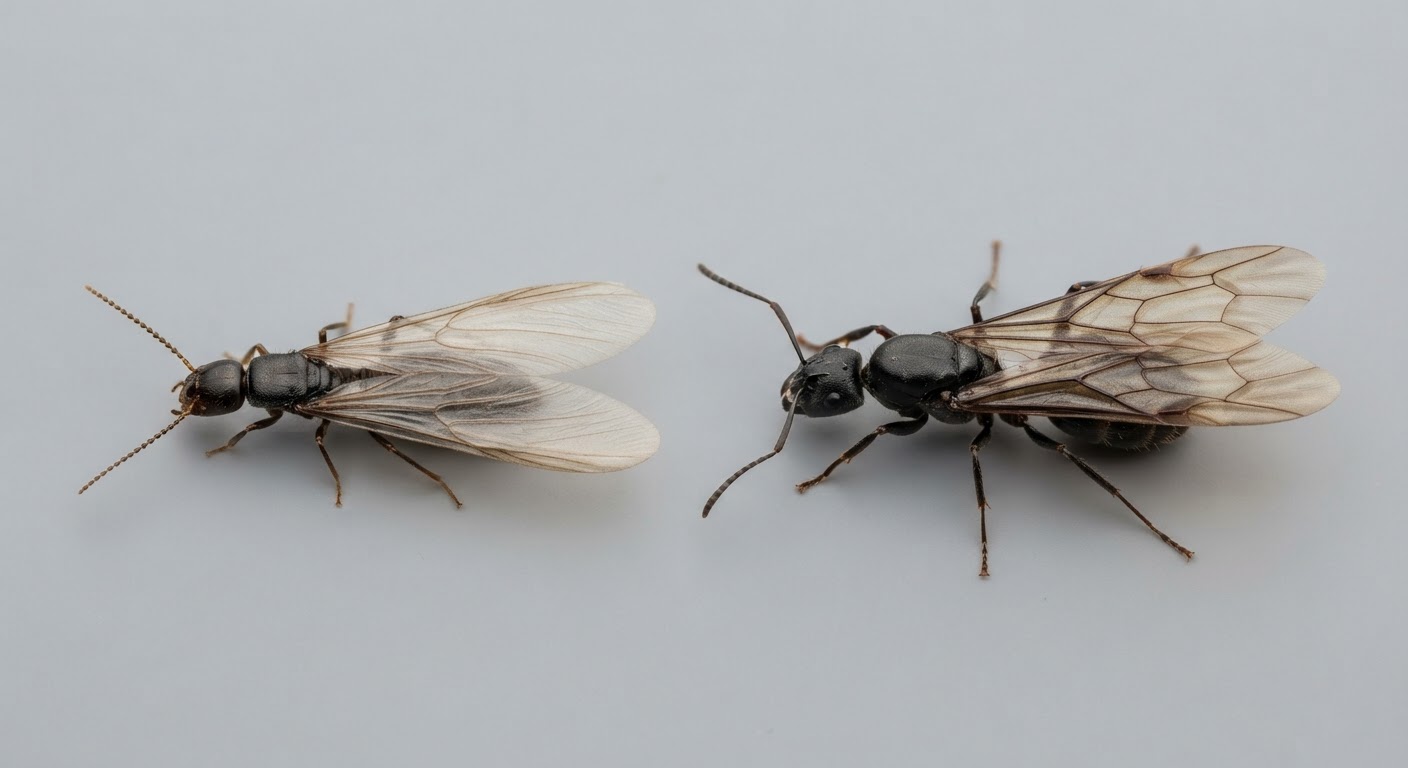
- Termite Swarmers: Termites have a uniform, cylindrical body. Their thorax (midsection) and abdomen blend together smoothly with no obvious indentation. When looking down at a termite swarmer, its body resembles a small, straight, oblong tube.
- Flying Ants: Ants possess a distinctly segmented body with three clear regions: head, thorax, and abdomen. Connecting the thorax to the abdomen is an extremely narrow, cinched section often described as an hourglass or wasp-like waist. This pinched waist is a definitive ant characteristic.
2. Antennae Structure
If you look closely at the insect's head, the antennae provide a definitive clue:
- Termite Swarmers: A termite's antennae are straight and flexible, resembling a tiny string of microscopic beads stacked one on top of the other. They do not bend at sharp angles.
- Flying Ants: An ant's antennae have a sharp, distinct bend in the middle, resembling a bent elbow or the letter "L." They feature a long base segment followed by an angled hinge and shorter tip segments.
3. Wing Size and Proportion
Both insects have two pairs of wings (four wings in total), but their size and pattern differ dramatically:
- Termite Swarmers: All four wings on a termite are virtually identical in size, shape, and appearance. They are long, paddle-like, and extend well past the end of the insect's abdomen—often doubling the visible length of the insect. The wings are typically milky, translucent, or smoky with very faint, fine veining.
- Flying Ants: An ant's front wings (forewings) are noticeably larger and longer than its hind wings. While ant wings also extend past the abdomen, the disproportion between the front and back pairs is clear. In addition, ant wings are transparent and feature prominent, dark, branching veins.
4. Color and Size
While color can vary depending on the specific species, general trends exist among common Mississippi pests:
- Subterranean Termite Swarmers: Jackson's most common structural pests—subterranean termites—typically produce swarmers that are dark brown to solid black, measuring about three-eighths of an inch long, including the wings.
- Flying Ants: Winged carpenter ants or common field ants can range widely in color, from reddish-brown and tan to completely black. Flying carpenter ants are often substantially larger than termite swarmers, sometimes reaching up to three-quarters of an inch in length.
The Evidence Left Behind: Shed Wings
You may not always catch the swarm in progress. Because swarming is a brief event often lasting less than an hour, homeowners frequently encounter only the aftermath. What the insects leave behind can identify them just as reliably as a live specimen.
Termite swarmers have naturally fragile wing attachments designed to snap off easily once they land, allowing them to crawl into soil or wood crevices to mate. If you find small piles of dropped, uniform, silvery wings scattered along window sills, door thresholds, or bathroom sinks, you are almost certainly dealing with termites. Flying ants, by comparison, retain their wings much longer and do not shed them in mass piles immediately after a short flight.
Why Accurate Identification Matters in Jackson
In Jackson and across the central Mississippi region, subterranean termites are an active reality due to warm soil temperatures, abundant rainfall, and moisture-rich ground conditions. If termite swarmers emerge inside your living space, it indicates an established colony is actively feeding on structural lumber or nesting beneath the foundation slab.
Flying ants can also signal trouble, particularly if they are carpenter ants, which excavate moist or decaying wood to create nesting galleries. However, carpenter ants do not eat cellulose; they hollow it out. While still a concern, carpenter ant infestations develop at a different pace and require completely different management protocols than subterranean termites, which ingest wood fiber around the clock.
What to Do After Spotting Swarmers
If you notice swarmers or discarded wings inside your property, take the following steps:
- Collect a Specimen: Save several insects or dropped wings in a sealed plastic bag or press them against clear tape. This gives a professional inspector tangible physical evidence to confirm the exact species.
- Do Not Rely on Surface Bug Sprays: Discharging aerosol insect sprays will kill the visible swarmers, but it does nothing to address the thousands of workers hidden inside the walls or beneath the soil. Over-the-counter chemicals can also cause colonies to scatter or relocate, complicating professional treatment.
- Check Exterior Foundation Lines: Inspect the exterior perimeter of your home for telltale mud tubes along masonry walls, crawlspace piers, or siding seams.
- Schedule a Professional Inspection: Have a licensed pest specialist evaluate the foundation, crawlspace, and structural elements to verify the extent of the activity and determine the right course of action.
Distinguishing between flying ants and termite swarmers is the first step toward safeguarding your home. If you have spotted winged insects, discarded wings, or signs of wood activity around your Jackson property, contact Prairie Lynx Pest Control today to schedule a thorough structural inspection and secure lasting protection.
Need help from Prairie Lynx Pest Control?
Contact our team to discuss your service needs in Jackson and surrounding service areas.