Liquid Termite Barriers vs. Bait Stations: Choosing the Right Defense for Your Jackson Home
Explore the key differences between liquid soil barriers and termite bait systems. Learn how each method operates, their installation processes, and how to choose the right subterranean termite defense for your property.
Subterranean termites represent a continuous challenge for homeowners across Mississippi. In our warm, humid climate, colonies remain active nearly year-round, foraging underground in search of cellulose found in framing, subflooring, and architectural timbers. Because these wood-destroying insects travel beneath the soil surface and build protective mud tubes, an untreated structure can harbor an infestation long before obvious surface damage emerges.
When establishing professional defense against subterranean termites, two primary methodologies dominate the industry: liquid soil barriers and in-ground baiting systems. Both strategies have evolved significantly over the years, yet they protect structures in fundamentally different ways. Understanding how each approach works, how they are installed, and how they perform in local conditions is essential for making an informed decision about safeguarding your property.
How Liquid Soil Barriers Work
Liquid termite treatments aim to create an unbroken barrier of termiticide in the soil immediately surrounding and beneath a home's foundation. The objective is to ensure that any termite attempting to tunnel toward structural wood must pass through treated soil.
Modern Non-Repellent Chemistries
In past decades, liquid treatments relied primarily on repellent chemicals intended to drive termites away from the foundation. If an applicator missed even a small gap in the treatment zone, foraging termites could exploit the opening to reach the structure. Modern professional liquid treatments utilize non-repellent chemistries. Termites cannot detect the presence of the product in the soil, meaning they freely travel through the treated zone.
As termites pass through the termiticide, the active ingredient adheres to their bodies. Subterranean termites are highly social creatures that groom one another, share food through trophallaxis, and maintain close physical contact within their underground networks. When an exposed worker returns to the nest, it transfers the active ingredient to nestmates, eventually spreading the product throughout the colony.
Installation Requirements for Liquid Barriers
Applying a continuous liquid barrier is labor-intensive and requires specialized equipment. The application process typically involves:
- Trenching: Technicians dig shallow trenches along the exterior foundation perimeter, applying liquid termiticide to saturate the backfilled soil.
- Rodding: Long metal injection rods are inserted deep into the soil along foundation walls, footings, and piers to distribute the product into deeper soil layers.
- Drilling: Where concrete elements such as patios, driveways, garages, or porches abut the exterior walls, technicians must drill small holes through the slab every few inches, inject the chemical into the substrate below, and seal the holes with specialized mortar or plugs.
- Crawlspace Treatment: For pier-and-beam foundations, the interior foundation walls and support piers must also be trenched or rodded to protect inner access points.
How Termite Baiting Stations Work
Rather than attempting to saturate the soil perimeter with liquid chemicals, baiting systems operate on the principle of interception and colony elimination through targeted feeding.
The Interception and Elimination Process
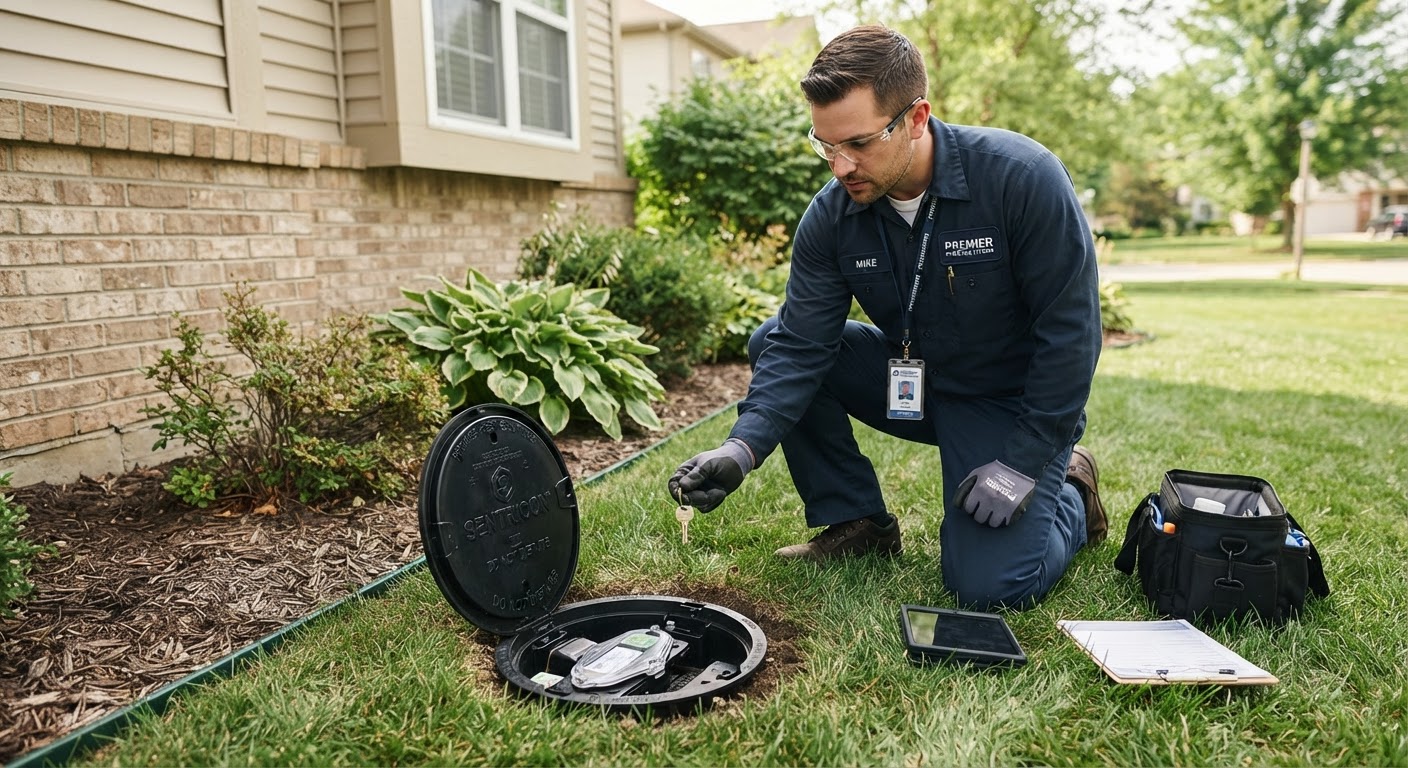
Termite bait systems utilize cylindrical plastic stations inserted flush into the soil around the exterior of a structure at regular intervals, typically every ten to twenty feet. Inside these stations, technicians place a cellulose-based material laced with a slow-acting active ingredient, typically an Insect Growth Regulator (IGR).
Subterranean worker termites forage randomly and continuously, even when a viable food source like a home's framing is nearby. When foraging termites discover a bait station, they feed on the cellulose and recruit other workers from the colony to the site. The slow-acting nature of an IGR is deliberate: if the compound killed workers immediately, surviving termites would recognize the area as hazardous and avoid the station. Instead, the IGR interferes with the termites' ability to molt and synthesize chitin. Over several weeks or months, the inability to shed their exoskeletons prevents the workers from maturing, causing the foraging population to collapse and leading to the eventual decline or complete elimination of the colony.
Installation and Maintenance of Bait Systems
Bait systems offer a less intrusive installation profile compared to continuous liquid applications:
- Coring and Insertion: Technicians use specialized augers to core small holes in the turf or garden beds around the home's perimeter, setting the station housings level with the soil line so they do not obstruct lawnmowers.
- Minimal Concrete Disruption: While stations can be installed through concrete using core drills when necessary, bait systems generally avoid extensive trenching or heavy drilling along the entire foundation edge.
- Ongoing Monitoring: Baiting systems rely on ongoing maintenance. A professional technician must inspect the stations on a scheduled basis to evaluate feeding activity, replace depleted bait cartridges, and ensure the stations remain intact and accessible.
Comparing Key Practical Factors
Choosing between these two termite defense methods depends on the structural realities of your home, environmental considerations, and your long-term maintenance preferences.
Speed of Protection
Liquid treatments offer immediate protection to the foundation envelope. Once the chemical is set in the soil, any termite attempting to breach that barrier is directly exposed. Bait systems, conversely, require termites to locate the stations, establish feeding trails, and transport the product back to the colony. While bait systems address the colony at its source, they take longer to suppress an active population compared to an immediate liquid application.
Impact on Landscaping and Hardscaping
For homes with extensive paved surfaces, wrap-around brick patios, or delicate perimeter plantings, liquid treatments can be invasive. Drilling through decorative slate, stamped concrete, or high-end tile may be necessary to ensure an unbroken barrier. Bait stations can often be placed outside these features or positioned strategically, minimizing structural alteration and disturbance to landscape roots.
Soil Type and Environmental Shifts
Jackson and surrounding areas in central Mississippi are well known for expansive soils, particularly Yazoo clay, which swells dramatically when wet and shrinks during dry summer periods. Severe soil movement can cause cracking or shifting along foundations. When heavy soils dry and pull away from foundation walls, gaps can theoretically compromise the continuity of a liquid chemical barrier. Bait stations are independent units placed in the soil, meaning that while they may shift slightly with ground movement, their mechanical function remains intact.
Long-Term Maintenance Commitment
A properly applied modern liquid barrier can protect a structure for several years without requiring frequent replacement of the chemical, though annual exterior inspections are still strongly advised to ensure no construction, landscaping, or erosion has disrupted the treatment zone. Bait systems, by design, require an active ongoing service plan. If stations run out of bait or are damaged by landscape equipment without being serviced, the home loses its defensive capability.
Selecting the Ideal Approach for Your Home
Neither system is universally superior; rather, each offers distinct benefits depending on the circumstances of the property.
- When Liquid Barriers Excel: Homes with straightforward soil perimeter access, minimal surrounding concrete, or those experiencing an immediate, aggressive subterranean termite intrusion where quick barrier establishment is essential.
- When Bait Stations Excel: Properties with complex architecture, extensive concrete porches, steep slopes, environmentally sensitive surroundings, or where homeowners prefer a low-impact installation that focuses on colony eradication.
- Combination Approaches: In cases of established interior infestations, professionals often utilize a hybrid strategy: spot-treating active interior and foundation areas with liquid termiticides or foams while installing a perimeter bait system to address surrounding colonies over the long term.
Ultimately, an effective termite management program begins with a thorough inspection of your foundation, crawlspace, and perimeter grounds to identify structural risks, moisture accumulation, and signs of subterranean activity.
Protect Your Property with Prairie Lynx Pest Control
Termite defense requires precision, local insight, and the right strategic approach for your specific home. If you want to evaluate your property's vulnerability or establish a reliable subterranean termite defense, contact the team at Prairie Lynx Pest Control today to schedule a comprehensive residential inspection in Jackson.
Need help from Prairie Lynx Pest Control?
Contact our team to discuss your service needs in Jackson and surrounding service areas.